Your Child Is Finally Asleep. So Why the Hell Can't You Relax?
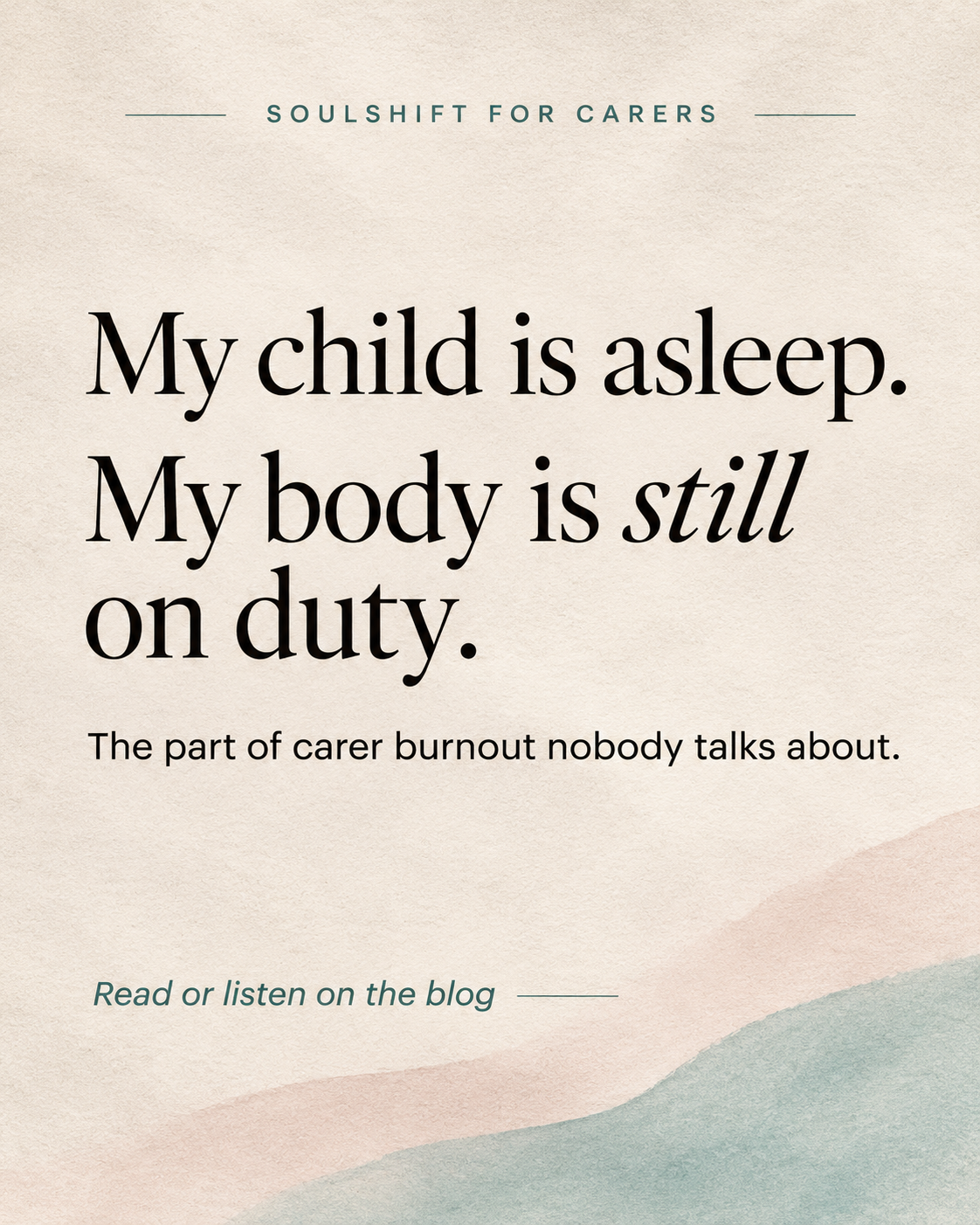
🎧 Rather listen than read?
I've recorded this article as a podcast, including a little guided nervous system reset at the end, just for you.
Spotify - Listen to the podcast here.
Apple Podcast - Listen here
YouTube Podcast - Listen here
Today I want to talk about something that I know so many special needs parents experience, but very few actually understand.
Have you ever had one of those days where you've been absolutely hanging out for a break?
You've been needed all day, been managing everyone else's emotions, anticipating meltdowns, making decisions, putting out fires, and probably haven't even had a chance to go to the bloody toilet by yourself.
And then it finally happens.
Your child's asleep, or somebody has taken over, maybe your kid's in respite, and you've actually got some time to yourself.
This is it, your chance to relax.
Except you can't.
You're lying on the couch, absolutely exhausted, but you can't settle. Your mind's racing. You're listening for noises. You're thinking about everything you need to do tomorrow or everything you should be doing.
Maybe you're feeling guilty because there's washing to fold or paperwork to finish. Or maybe you're not thinking about anything in particular.
You just have this uncomfortable, restless feeling in your body.
And the really frustrating part? You've been so desperate for this break all day.
So why the hell can't you enjoy it?
Well, there's actually a physiological explanation for some of this. And once you start to understand what's happening in your nervous system, so much of what we experience as carers starts to make sense.
Because here's something I really want you to understand.
Just because you've stopped doing things doesn't necessarily mean your body has stopped responding to stress.
Now, if you're new here, I'm Jade. I'm a somatic practitioner, a special needs mum, and the founder of Soul Shift for Carers.
I've also experienced severe care burnout myself. And I now spend a lot of time helping parents understand their nervous systems, recognize what's happening in their bodies, and find ways to support themselves through the enormous demands of caring.
And this is one of the biggest things I wish someone had explained to me years ago.
Your body doesn't just respond to what's happening right now. It also responds to what it's learnt to expect.
Think about that for a second.
If you've spent years caring for a child whose needs can change in an instant, your nervous system has had a lot of practice anticipating what might happen next.
The sudden screaming, the headbanging, the aggression or behaviours that put somebody at risk, the child who might run out the front door, the medical emergencies, the sleepless nights, or the constant worry about whether your child is or whether their needs are being met, or whether you're going to lose the support you fought so hard to get.
And that's before we even start talking about school meetings, NDIS reviews, medical appointments, financial pressures, and all the other shit that comes with being a carer.
For a lot of us, there isn't really an off switch.
Even when nothing is happening, we're still anticipating what could happen.
And that's where our nervous system comes into the picture.
So let's talk a little bit about what's actually happening inside your body. And I promise I won't turn this into a bloody biology lesson.
Your autonomic nervous system helps regulate things like your heart rate, breathing, digestion, and stress responses.
And when your brain and your body detect something stressful or threatening, they can activate what's commonly known as your fight or flight response.
Your heart might start beating faster, your breathing changes, your muscles tense, your attention becomes more focused.
Stress hormones like adrenaline and cortisol help your body respond to the situation.
And this is actually a really clever system. It's designed to help us meet challenges and respond to danger.
So if you quickly need to grab your child before they run onto the road, you don't want your body to sit there casually just considering its options.
You need to move, and your nervous system helps you do that.
But here's where things can get complicated.
What happens when the stressful situations don't really stop?
What happens when your sleep is interrupted night after night for years or decades?
Or when you barely recover from one crisis before the next one arrives?
When you're spending years responding to situations that require you to be constantly alert?
Well, prolonged stress can start affecting all sorts of things: your sleep, concentration, emotional responses, your digestion, your physical health, and your ability to cope with things that wouldn't normally bother you.
You might find yourself getting overwhelmed by noises.
Losing your patience over tiny things, feeling anxious even when nothing particularly stressful is happening, or being so exhausted that even making a simple decision feels impossible.
And for some people, it isn't anxiety or restlessness that stands out, it's numbness, that feeling of being disconnected from everything, like you're going through the motions, doing all the things you have to do, but not really feeling present for any of them.
I hear this from parents all the time.
They say things like, I don't even feel like a person anymore. I don't remember what I enjoy. I'm not living, I'm just existing.
And I think we need to start taking those words a lot more seriously.
Now, something I find really interesting is what can happen when people finally get an opportunity to rest.
Because we tend to assume that if somebody is exhausted, all they need to do is stop, take a break, go on a holiday, have a sleep.
And obviously, adequate sleep and rest are incredibly important.
But sometimes, especially when somebody has experienced prolonged stress or trauma, slowing down can initially feel quite uncomfortable.
You might lie down to meditate and suddenly feel more anxious.
You might sit in silence and notice how tense your body is.
Or you might finally get a weekend without your usual caring responsibilities and spend half of it feeling restless, guilty, or completely unable to switch off.
Now, this doesn't happen to everyone, but it is something I see a lot in my work.
And it can be really confusing because you think, What the hell is wrong with me? I've finally got what I've been asking for, and I still can't relax.
But here's how I like to explain it.
Imagine you've spent years living in an environment where you need to be ready to respond at any moment.
Your body has become very familiar with that level of alertness.
So when you suddenly become still, it doesn't feel familiar at all.
And unfamiliar doesn't feel comfortable.
Sometimes your thoughts become louder.
Sometimes you notice sensations you've been too busy to pay attention to.
And sometimes you just don't know what to do with yourself when nobody needs you.
That doesn't mean you should stop resting.
It means you might benefit from finding ways to help your body approach rest gradually, instead of expecting yourself to go from 100 miles an hour to completely calm in five minutes.
And that brings me to something I'm incredibly passionate about: somatic work.
Now, if you've followed me for a while, you've probably heard me talk about somatic practices.
But if you're new, somatic simply means relating to the body.
And somatic work is about paying attention to what's happening in your body, not just what's happening in your thoughts.
Because so much of our stress shows up physically.
Think about it.
When you're frustrated, what happens to your jaw?
When you're worried, what happens to your stomach?
When you're overwhelmed, what happens to your shoulders?
When something frightens you, what happens to your breathing?
Our bodies are constantly responding to our experiences.
But as carers, we're often so busy focusing on everybody else's needs that we barely notice our own.
Until something starts hurting, or we get really sick, or we reach the point where we simply can't keep going the way we have been.
So somatic practices give us an opportunity to start paying attention again.
And one of the things I absolutely love about this work is that our bodies already have so many natural responses that can help us manage stress.
Think about sighing, or stretching, or just shaking your hands when you're frustrated, or having a really good cry, or moving around when you've got all this restless energy.
We don't have to invent an entirely new way of being human.
We just start by noticing some of the things our body already does and exploring which ones help us feel more comfortable.
And you know who the experts are of this?
Some of our greatest teachers, our kids.
Seriously, I have learned so much from watching my own daughter.
For years, she would tap different points on her face.
And as I learned more about somatic practices, I started recognizing similarities between what she was doing and some of the tapping techniques I'd been learning about, which is EFT.
I started watching her closely, and she had been tapping the exact spots on her face that they teach in EFT tapping.
I could not believe it.
And this had been happening for eight or nine years without me even realizing.
Now, I would never be able to teach my daughter to do that. That she has a severe intellectual disability and profound autism.
But our kids' bodies are so clever.
It just taught itself that that felt good, and she kept doing it.
So our children have their own ways of seeking sensory input, expressing themselves, and trying to manage what they're feeling.
And we can learn so much by paying attention to them.
And I think sometimes we get caught up in trying to teach our kids how to regulate that we forget to be curious about the ways they're already trying.
And I love that.
So what does this actually look like for an exhausted special needs mum?
Well, the good news is that it doesn't have to involve sitting cross-legged with your eyes closed for half an hour.
Because I know for some of you, the idea of finding 30 uninterrupted minutes is absolutely laughable.
Sometimes we start with 30 seconds, noticing the tension in your shoulders, pressing your feet against the floor, having a long, comfortable breath out, stretching your arms, or taking a moment to look around and notice something pleasant in your environment.
Different things help different people.
If you're feeling restless and full of nervous energy, you might find some gentle movement helpful.
If you're feeling overwhelmed, you might prefer something slower and more grounding.
And if you're feeling completely depleted, perhaps you need comfort, connection, proper rest, or practical support before you need another exercise.
There's no one-size-fits-all approach, and I never want nervous system regulation to become another thing on your already enormous to-do list.
The goal isn't to become perfectly calm.
The goal is to build awareness of what your body needs and gradually develop more options for supporting yourself.
And something else I see in my work is that when parents begin to feel a little bit more supported and regulated, it changes the way they respond to their children, and it changes their children's behaviors.
And that has a huge impact on their relationship as well.
And then we have co-regulation, and that is a whole other thing.
But in a nutshell, their nervous system is constantly scanning ours for danger.
And the other thing is when we have a bit more capacity.
We can respond with more patience, feel less overwhelmed, and just be more present, and that can make a meaningful difference.
Now, before I go any further, there's something I really need to say.
And honestly, I think this is one of the most important parts of this whole conversation.
You cannot regulate your way out of an unsustainable caring situation.
I want you to really hear that, because I'm incredibly passionate about nervous system regulation.
I see the benefits of somatic practices in my work every day.
I've experienced those benefits in my own life, but I also know firsthand what it's like to live in circumstances that are simply too much for one human being to manage.
And we cannot keep telling carers to practice self-care while ignoring the actual conditions that they're living in.
You can't breathe your way out of chronic sleep deprivation.
You can't meditate your way into adequate support or respite.
And no amount of positive thinking and gratitude will result in disability support workers magically showing up at your door to help.
We need both.
We need to help parents look after their nervous systems, and we need to make sure they have the practical support, resources, and opportunities for rest that every human being deserves.
This is something I'll continue advocating for because I genuinely believe we've spent far too long focusing on the needs of the person receiving care while completely overlooking the health and wellbeing of the person providing it.
And I want to be really clear here.
This isn't about taking anything away from our children.
Our children deserve every bit of support that they need, but so do we.
And our children's rights and our rights as carers should never have to compete with one another.
So if you've been listening to this and recognizing yourself in some of the things I've described, I want you to know that there are ways to start supporting yourself, and they don't all involve adding more things to your day.
Sometimes it's learning to recognize that you're becoming overwhelmed before you reach breaking point.
Sometimes it's finding a practice that helps ease a little of the physical tension you're carrying.
Sometimes it's connecting with other people who understand what your life looks like.
Sometimes it's getting professional support, and other times it's recognizing that you need genuine practical changes, not another coping strategy.
And if there's one thing I hope you take away from this conversation, it's this.
You're allowed to be more than the person who keeps everybody else going.
You're allowed to have needs.
You're allowed to want things for yourself.
You're allowed to experience joy, pleasure, connection, and rest.
And you're allowed to ask for support before you reach the point where your body simply cannot keep going, because you matter too.
Now, before you go, I want to give you something, just a little minute for yourself, because we've spent all this time talking about nervous system regulation, and I'd love for you to actually experience what it feels like to give your body a little bit of attention.
So if you're driving or doing something that needs your attention, just come back to this part later.
Otherwise, wherever you are, see if you can get a little comfortable.
You don't need to close your eyes or sit in any particular position.
Just let yourself be here for a moment.
And first, I want you to notice your shoulders.
Where are they sitting?
Are they up around your ears?
Are you holding them really tight?
If it feels comfortable, just gently lift them up towards your ears.
And now I want you to hold them.
And let them drop.
Beautiful.
Let's do it one more time.
Lift those shoulders up towards your ears.
Hold for a moment.
Let them go.
Now bring your attention to your jaw.
Are your teeth pressed together?
Are you holding tension in your cheeks?
See if you can create a little space between your teeth, the top and the bottom teeth.
You might want to let your lips part.
Let your tongue rest comfortably.
You don't have to force anything here.
Just allow that area to soften a little.
And now we're going to do one of my favorite things, a lovely exaggerated sigh, because sometimes our bodies just want a good bloody sigh, don't they?
So if it feels okay, take a gentle breath in and let it out with a big sigh.
Lovely.
Let's do one more.
Breathing in and sighing it all the way out.
Now just notice, does anything feel different?
Maybe your shoulders have softened or your jaw feels a bit less tight.
Maybe your breathing feels a bit easier.
Or maybe you haven't noticed much of that at all.
That's okay.
We're not trying to force your body to feel anything in particular.
We're just giving it an opportunity to notice, to move, and perhaps to soften a little.
And I'd love you to take just one more moment.
Feel where your body is supported.
Maybe it's your feet on the floor or your back against the chair.
Just notice the support beneath you.
And if you feel comfortable.
Just gently remind yourself, I'm matter too.
My needs matter too.
I deserve care and support.
You don't have to earn rest.
You don't have to wait until you've done absolutely everything for everybody else, and you don't have to reach breaking point before you're allowed to ask for help.
And that's it.
Just a moment for you, because I know how easy it is to spend your entire day paying attention to everybody else's needs and completely forget that you have a body that needs looking after too.
And sometimes this is where we begin, not by changing everything overnight, but by finding these little moments to reconnect with ourselves.
And if you enjoyed that and you'd like to explore more of this work, I'd love to invite you into the sanctuary.
It's a space I've created for carers who spend so much of their lives looking after everyone else that they've forgotten what it feels like to be looked after themselves.
We come together for live somatic sessions, guided relaxation, nervous system practices, and connection.
And it's not about adding more pressure or giving you another thing that you have to get right.
It's just about giving you a space where, for a little while, you can stop being the person that has to hold everything together.
You can just show up as you are, whether you're feeling overwhelmed, exhausted, anxious, emotional, or you just want to reconnect with yourself a little.
You'll find all the information about the sanctuary on my website, soulshiftforcarers.com.
And whether you join us or not, I really hope something from this conversation has helped you understand yourself a little better, because being a carer might be a huge part of your life, but it is not all that you are, and you deserve to feel like yourself again.
Thanks so much for spending this time with me.
Jade x
P.S. For more info on The Sanctuary - tap here